
By Yossi Bar, CEO and Founder of LEM Surgical. September 2nd, 2026.
The robotics industry is currently experiencing an unprecedented influx of capital, media attention, and public fascination. However, when trying to assess where autonomous robotics will achieve true commercial viability and market traction first, we must look critically beyond the prevailing hype. The ultimate success of an autonomous robot does not depend solely on the sophistication of its artificial intelligence or the mechanical agility of its hardware. Instead, it depends fundamentally on the predictability of the environment where they operate. By examining the history of automation alongside current investment trends, we can confidently chart where autonomous robotics will succeed next.
Article Overview:
- Episode 1: The Specialty Within Generality and Environmental Predictability: Highlights why general purpose AI still requires specialized physical hardware and establishes environmental predictability as the ultimate key to autonomous success.
- Episode 2: The Aviation Blueprint and the Automotive Struggle: Contrasts how the highly structured and controlled environment of the open sky allowed commercial aviation to achieve autonomy decades ago, against the unpredictable and chaotic nature of city streets that continues to delay the commercial viability of self driving cars.
- Episode 3: The Counterintuitive Reality of the Operating Room: Reveals why the strictly regulated surgical theater is actually a much more achievable environment for robotics than a chaotic domestic household.
- Episode 4: The First Frontier in Surgical Autonomy: Concludes that the rigid, static nature of hard tissue provides the perfect predictable environment for the first true commercial applications of autonomous surgery.
Episode 1: The Specialty Within Generality and Environmental Predictability
Right now, a massive portion of venture capital money and attention flows to back general purpose humanoid robots. The prevailing narrative in the technology sector suggests that, in the near future, the same humanoid robot will be able to fold shirts in any household, assemble cars in factories, and perform surgeries. The driving belief among many investors and other stakeholders is that if engineers build a sufficiently advanced general purpose robot, that single machine will be capable of doing absolutely everything across any environment.
The Specialty Required Within Generality
This overgeneralized mindset overlooks the fundamental need for specialization within generality. While humanoid robots inherently excel in generality compared to previous generations of single task robots, substantially different environments will still require specialized humanoids [1]. Artificial intelligence cannot be separated from its physical hardware. A robot built to fold shirts in households will just not possess the delicate kinematics, tool mastery, and strict regulatory adherence required to perform surgery. Put simply, even we humans, who can explain everything there is to say about monkeys, trees, and gravity, cannot climb trees like monkeys. We simply lack their specific physical form factor. Cognitive intelligence alone cannot compensate for the lack of a specialized physical embodiment.
The Supremacy of Environmental Predictability
It is very important not to underestimate the critical role of environmental predictability. The monumental challenge in autonomous robotics is designing a robot that can understand, anticipate, and safely react to an infinite number of unknown variables in an ever changing environment.
Consider the domestic environment. Counterintuitively, trusting a humanoid robot to organize a child’s bedroom while toddlers are unpredictably crawling on the floor might be found to be a more difficult task than performing surgery on a live patient. The argument in this article is not that it is not achievable, but that it is not necessarily the “low hanging fruit”. When we ask where the first commercially viable applications for autonomous robots will emerge, the answer is clear. It will emerge in highly regulated, thus controlled, and therefore predictable environments. Unlike what we may intuitively think, the more regulated and controlled the environment, the more predictable it becomes, and therefore more suited for robotic automation [5].
Episode 2: The Aviation Blueprint and the Automotive Struggle
Intuitively, most people assume that automating a ground vehicle is easier than an airplane. Flying involves navigating six degrees of freedom, which is why there are far more car drivers than pilots. Furthermore, if a problem occurs, a car can simply pull over and stop, whereas an airplane cannot. However, the reality is entirely counterintuitive. To understand this trajectory, we must look at historical precedents in automation by contrasting two distinctly different environments.
The Aviation Blueprint
Commercial aviation successfully integrated autopilot systems decades ago, allowing computers to fly massive passenger jets across oceans with minimal human input. This rapid advancement was not possible because 1980s computer technology was superior to modern artificial intelligence. It was possible entirely because of the environment.
The open sky is a highly predictable, strictly regulated, and profoundly controlled space. Flight paths are standardized, air traffic is meticulously managed by centralized controllers, and the physical variables such as altitude and wind speed are well defined. In such a structured setting, there are very few sudden obstacles. Machines can rely on mathematical algorithms and sensor data to navigate safely without requiring constant, second by second human intervention. Predictability and strict environmental control serve as the absolute foundation for early autonomous success.
The Automotive Struggle in Chaotic Environments
Conversely, the automotive industry continues to struggle immensely with delivering fully autonomous self driving cars to the mass market, despite billions of dollars in funding. A city street is the exact opposite of the open sky. It is a chaotic, unstructured, and highly volatile environment.
A self driving car must navigate a world filled with unpredictable pedestrians, sudden weather changes, erratic human drivers, stray animals, and poorly defined construction zones. These are known as “edge cases” in computer science. While the artificial intelligence inside a modern autonomous vehicle is remarkably advanced, the environment itself actively resists automation. The system must constantly calculate infinite unknown variables in real time. If a sensor misinterprets a shadow for a pedestrian, the result can be catastrophic. Therefore, commercial traction for full autonomy stalls heavily in chaotic environments because the computational load of unpredictability is simply too high.
Episode 3: The Counterintuitive Reality of the Operating Room
This concept of environmental predictability translates directly to the medical field and the future of robotic surgery. When presented with the facts, it often sounds counterintuitive to the general public. It seems logical to assume that folding a shirt is highly doable and performing surgery is impossibly difficult for an autonomous robot. However, from an autonomous engineering perspective, in real world applications and not just in controlled labs, it is actually more achievable to deploy a robot to perform autonomous surgical tasks than it is to bring a robot to fold a shirt in a chaotic kids’ room.
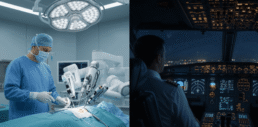
The operating room is one of the most highly regulated and controlled spaces on earth. Similar to the aviation industry, strict protocols govern every single action. The lighting is perfectly optimized, the temperature is controlled, and the patient is meticulously positioned and anesthetized. The space is entirely cleared of unpredictable elements and strictly governed by highly trained individuals. Everything has a place, and everything is in its place. Because the operating room provides the strict regulation and environmental control necessary for machines to function safely, the surgical theater presents an ideal landscape for the next major commercial leap in autonomous robotics [3].
Episode 4: The First Frontier in Surgical Autonomy
However, simply being in an operating room is not enough. Within this highly controlled environment, we must apply the exact same environmental test to the human anatomy itself.
Soft tissue surgery, which includes operations on the heart, lungs, and digestive tract, involves organs that constantly shift, deflate, and deform. A beating heart or a breathing lung mimics the chaotic, unpredictable environment of a busy city street. Furthermore, beyond the body’s natural and intrinsic motion, the surgical activity itself creates countless motions and unpredictable reactions. Merely by sticking a needle into the tissue, the mechanical reaction of the tissue to this action is completely unpredictable and therefore must be continuously monitored and analyzed. The anatomical landscape is constantly changing, meaning an autonomous robot would have to continuously recalculate its position and actions to avoid catastrophic errors.
Hard tissue, conversely, reveals itself as the most prominent field for autonomous surgery. In orthopedic and spinal procedures, the bone by its very nature is rigid and possesses a structured construct [2]. Once a patient’s skeletal structure is adequately secured and mapped via advanced high resolution imaging, its topography provides a highly predictable and unyielding framework. The bone does not suddenly morph or change shape. While bones can move in ways that require tracking, a sophisticated system handles this as a geometric and scientific task rather than an organic guesswork problem, knowing precisely where the anatomical boundaries are located, much like an autopilot system knows its precise altitude and heading.
Summary
The commercial deployment and widespread traction of autonomous robotics will not be decided merely by who builds the most versatile humanoid for unstructured consumer spaces. Instead, commercial scale will be achieved where advanced robotics meets predictable environments, emphasizing that the first true wave of autonomy will probably arrive in the operating room long before it reaches the domestic household. Just as the commercial airplane achieved safe autonomy decades before the passenger car, highly structured environments will always lead the technological revolution. By recognizing that hard tissue surgery provides the structural predictability of the open sky, we can clearly see the future. Hard tissue robotic surgery will undoubtedly become the very first commercially viable frontier for autonomous systems, confirming that precision and predictability are the true catalysts for automation and scalability [4].
References:
- Bar, Y. (2026). “Article 3: Built Different: Why Physical AI Demunds Environment-Specific Hardware.” (Referencing the necessity of matching physical robotic architecture to the specific constraints of its operating environment).
- Bar, Y. (2026). “Article 4: Hard Tissue vs. Soft Tissue: The Physics of Robotic Surgery.” (Referencing our earlier discussion on the rigidity of skeletal structures in orthopedic and spinal procedures compared to the chaotic environment of deformable organs).
- Bar, Y. (2026). “Article 2: Next Generation Surgical Humanoids- From Trajectory Guide to Therapeutic Executor.” (Referencing the evolution of surgical robots from passive guides into active executors, a technological leap made possible by the strict environmental control of the operating room).
- Bar, Y. (2025). “Article 5: Physical AI and the Transition to Bimanual Surgical Humanoids.” (Referencing the architectural requirements for executing complex tasks in hard tissue surgery and controlled settings).
- Parasuraman, R., Sheridan, T. B., & Wickens, C. D. (2000). “A model for types and levels of human interaction with automation.” IEEE Transactions on Systems, Man, and Cybernetics, Part A: Systems and Humans, Vol. 30, Issue 3, pp. 286-297. (A foundational peer-reviewed paper defining how highly controlled environments dictate the success, safety, and commercial viability of autonomous systems). Link: https://ieeexplore.ieee.org/document/844354