
Data is the New Commodity, While the Surgical Robot is the True Enabler of the New Economy
By Yossi Bar, CEO and Founder of LEM Surgical. July 9th, 2026.
Article Preview: Chapter Ledger
- Preview
- The Need for Comprehensive Data Harvesters
2.1. The Physical Harvest of Digital Data
2.2. The “One-Trick Pony” Plateau and Missed Opportunities
2.3. Breaking Data Silos with Unified Robotic Platforms
2.4. From Subjective Art to Objective Science: The Closed-Loop Outcome Equation
- Three Examples of Disruptive Business Models for the Data-Driven Surgical Economy
3.1. Dynamic Value-Based Reimbursement and Intelligent CPT Coding
3.2. Surgical Data as a Service (DaaS) and Global Federated Learning
3.3. Predictive Ecosystems, Pay-Per-Insight and Implant-Agnostic Optimization
- The Intellectual Property Moat: The Cost of Late Entry
- Summary
- Preview
In the current landscape of surgical intervention, particularly within hard tissue surgery, the financial ecosystem revolves primarily around implanted hardware (such as spine, knee, and hip implants), consumable hardware (including staples, needles, and cutters), and biologics (such as bone grafts and tissue substitutes). However, the future economy of healthcare will undeniably shift its gravitational center toward a new commodity: Data.
This new paradigm will be fueled by systems performance data, patient outcomes, and operational data from hospitals and personnel.
This transition toward a data-driven digital ecosystem is already widely envisioned and pursued by leading healthcare institutions and early pioneers in soft tissue robotics, such as Intuitive Surgical [1]. Yet, amidst the enthusiasm for artificial intelligence and machine learning, many stakeholders underestimate the crucial role of the physical component within the concept of Physical AI. While post-operative data mining and retrospective analysis hold immense value, the true keys to the kingdom will belong to those who possess the most effective data-harvesting machines operating routinely within hospital wards and operating rooms.
Before exploring the economics of surgical data, we must establish a core principle. The industry’s primary goal is not mere data monetization, but providing superior tools to improve patient care. Nevertheless, data-driven platforms are inevitable, as rigorous analysis will ultimately drive these health improvements.
- The Need for Comprehensive Data Harvesters
2.1. The Physical Harvest of Digital Data
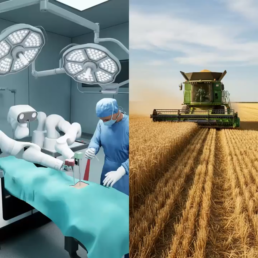
To understand this dynamic, consider a simple agricultural analogy. In this new healthcare economy, surgical data represents the raw grain, the essential yield that fuels the entire system. Artificial intelligence and machine learning act as the brilliant scientists optimizing the genetics of the seeds, or the master bakers crafting the perfect recipes. Yet, all of this digital sophistication remains purely theoretical without the physical harvest. A comprehensive surgical data-harvesting machine serves as the advanced combine harvester working directly in the field. Without a robust, physical machine actively gathering the raw crop at the point of care, there is simply no grain for the AI to process.
The most efficient and successful data-harvesting machines are surgical robots. These advanced systems possess the unique capacity to engage across the entire clinical continuum. Positioned centrally within the operating theater, they serve as highly equipped platforms featuring both passive sensing and active interventional capabilities. In the realm of soft tissue surgery, significant progress has been achieved. However, hard tissue surgery remains considerably behind. While robotic utilization is growing, with the American Academy of Orthopaedic Surgeons [2] estimating that robotic total knee arthroplasties will jump from roughly 13 percent today to 50 percent by 2030, the actual participation of these robots during the surgery reveals a massive gap.
2.2. The “One-Trick Pony” Plateau and Missed Opportunities
Currently, many hard tissue robots function as “one-trick ponies.” In spine surgery, for instance, contemporary clinical data shows that while total procedure times average around 196 minutes, the robot is actively utilized for only about 31 minutes, which represents a mere 16 percent of the surgery [3]. The robotic platform is almost exclusively relegated to pedicle screw trajectory alignment. This leaves the vast majority of the surgical workflow, such as decompression, interbody preparation, and rod placement, completely untracked and manually executed. Similarly, in joint replacement procedures, the robot is typically limited to executing bone resections, while crucial steps like soft tissue balancing and final implant seating remain unmonitored manual tasks.
These unmonitored phases represent massive missed opportunities for data harvesting. Simply adding sensors to current robots is insufficient. Because these limited systems lack clinical utility during the remaining surgical steps, they are inevitably rolled away from the table. Surgical teams will not tolerate redundant, obtrusive equipment in a crowded operating room merely to collect data. To achieve meaningful data capture at scale, next-generation surgical robots must be comprehensive. They must actively participate in all phases of the surgery, utilizing advanced sensors to record everything, thereby transforming undocumented manual steps into measurable digital assets.
2.3. Breaking Data Silos with Unified Robotic Platforms
Furthermore, to truly capitalize on this wealth of surgical information, the industry must move beyond the fragmented approach of utilizing different robotic systems for different clinical applications. Deploying one robot for spine surgery, another for total knee arthroplasties, and yet another for hip replacements (which are often manufactured by entirely different companies) creates siloed and incompatible datasets. Instead, there is a critical need for a unified, multi-application robotic platform capable of executing all hard tissue cases. A singular system ensures harmonized data architecture and standardized collection methods across diverse procedures. This unified approach eliminates structural discrepancies in the collected information, producing the consistent and high-fidelity data foundation required to train robust Physical AI models across the entire orthopedic spectrum.
2.4. From Subjective Art to Objective Science:
Critics rightly note that surgical outcomes in complex hard tissue procedures are multi-factorial. Patient genetics, bone quality, and co-morbidities significantly influence recovery, meaning intra-operative data alone cannot perfectly predict success. Instead, this data is one critical piece of a larger puzzle. Its true value lies in quantifying clinical outcomes to move surgery from a subjective art to an objective science. To achieve this, the robotic platform serves as the engine for a closed-loop correlation equation.
This mechanism works in three distinct steps. First, the surgeon diagnoses the pathology and formulates a preoperative plan, which the robotic platform crafts and suggests as the optimal approach. Second, the robot assists in the procedure while capturing concrete data, such as bone resection volumes, real-time tissue tension, or micromillimeter variance in implant alignment. The system uses this data to quantify the exact difference between the intended plan and the physical execution. Third, this objective record is compared directly to actual postoperative recovery, measuring improvements like pain reduction or increased mobility.
Over time, this closed-loop system creates a robust correlation linkage between the diagnosis, planned treatment, quantified execution, and final clinical improvements. This rigorous quantification will undeniably enhance our understanding of how specific surgical actions affect outcomes, enabling highly predictable care.
However, the success of this paradigm rests on one fundamental requirement: the robotic platform must be clinically comprehensive and complete.
- Three Examples of Disruptive Business Models for the Data-Driven Surgical Economy
When physical AI platforms seamlessly capture comprehensive procedural data, they open the door to revolutionary business models where all stakeholders win: the patients, the insurance providers, the hospitals, and the medical technology companies. These three models represent just the foundation, while the future applications for this data are limitless.
3.1. Dynamic Value-Based Reimbursement and Intelligent CPT Coding
In this model, the data captured by the surgical robot serves as an indisputable ledger of surgical quality and efficiency. By recording objective metrics such as tissue handling, implant placement accuracy, and procedure time, the platform can automatically generate compliance reports that correlate with superior patient outcomes. Insurance companies can leverage this validated data to establish dynamic reimbursement tiers. Hospitals utilizing comprehensive robotics to achieve higher safety standards would unlock premium Current Procedural Terminology (CPT) codes or higher reimbursement rates. Patients benefit from safer procedures, insurers save on the costs of revision surgeries, and hospitals maximize their revenue while delivering better care.
3.2. Surgical Data as a Service (DaaS) and Global Federated Learning
A comprehensive surgical robot acts as a node in a massive, decentralized intelligence network. Through federated learning, hospitals can securely share anonymized procedural data to train global AI models without compromising patient privacy [4]. In this business model, hospitals are not just consumers of technology; they become data contributors. Medical device companies can subsidize the capital cost of the robotic hardware in exchange for continuous access to this high-quality training data. Hospitals reduce their financial burden, the manufacturing companies accelerate the development of their Physical AI algorithms, and patients worldwide benefit from a continuously improving standard of care. Furthermore, open platforms can ease data exchange among stakeholders, enhancing overall surgical outcomes at scale [5].
3.3. Predictive Ecosystems, Pay-Per-Insight and Implant-Agnostic Optimization
By capturing data across thousands of procedures, next-generation robotic platforms can perfectly map the utilization of operating room resources, predicting exactly which implants and tools are required for specific patient anatomies. This enables a “pay-per-insight” or smart inventory model. Currently, even when hospitals do not purchase costly inventories upfront, they often require medical device companies to hold these items on site under consignment. The industry bears the heavy financial burden of maintaining this redundant inventory, a cost that is inevitably rolled back to the hospital through higher implant prices. Instead, the robotic platform’s data engine can direct a highly optimized supply chain. Because the true value lies in the data and the execution, the hardware platform can remain completely implant-agnostic. Hospitals drastically reduce these hidden inventory overheads, insurance companies see a reduction in overall procedural costs, and device companies generate recurring revenue through software analytics and predictive maintenance subscriptions.
- The Intellectual Property Moat: The Cost of Late Entry
In the software industry, entering a market late often allows a company to learn from early mistakes and quickly pivot through agile coding. Hardware development presents a starkly different reality. In the realm of physical medical technology, entering the game too late can make market penetration almost impossible due to strict patent protections. Physical patents create insurmountable barriers that completely block competitors from developing similar mechanisms and system architectures.
The historical precedent for this is undeniable. Intuitive Surgical established an impenetrable intellectual property wall with its da Vinci system. By securing foundational patents, the company effectively locked out competitors and maintained a near monopoly over the soft tissue robotic surgery market for approximately 20 years. It was only when these core patents began to expire that other major medical technology companies could finally introduce their own systems to the market [6]. However, this prolonged exclusion delayed competitors to such an extent that Intuitive was already vastly advanced and deeply entrenched in the clinical workflow. Consequently, even today, long after those initial patents have expired, rival companies still find it nearly impossible to close the market gap.
As the industry transitions into hard tissue robotics and Physical AI, the same dynamic is unfolding. Companies that delay the development of comprehensive surgical robotic systems will find themselves locked out by newly established patent portfolios. While high quality data is the ultimate gain and the currency of the future economy, the physical hardware platform is the mandatory enabler. Without the patented hardware required to physically operate inside the operating room, a company simply cannot participate in the data revolution.
- Summary
While data is undeniably the new commodity of the surgical economy, it is the physical hardware platform that remains the ultimate enabler. The future belongs to comprehensive robotic systems that are fully integrated into the surgical workflow. By acting as complete data-harvesting machines, these next-generation robots will transition the industry from Surgery 2.0 to Surgery 3.0, unlocking disruptive business models that align clinical excellence with economic efficiency. Furthermore, securing early patents is paramount. The companies that establish robust intellectual property portfolios now will cement their leadership in this surgical revolution, while latecomers risk being excluded from the new data economy for decades to come.
References
[1] Asciak, L., Kyeremeh, J., Luo, X., et al. (2025). Digital twin assisted surgery, concept, opportunities, and challenges. npj Digital Medicine, 8.
[2] American Academy of Orthopaedic Surgeons (AAOS). (2025). Robotics Help Improve Precision, Personalization of Knee Replacement Surgery.
[3] PRoGRSS Study Group. (2024). Comprehensive Outcomes Following Navigated Robotics in Thoracolumbar Spine Surgery: The PRoGRSS Final Analysis. PMC.
[4] Chaudjary, S., Kakkar, R., Gupta, R., et al. (2022). Blockchain and federated learning-based security solutions for telesurgery system: a comprehensive review. Turkish Journal of Electrical Engineering and Computer Sciences, 30, 2446-2488.
[5] Görtz, M., Byczkowski, M., Rath, M., et al. (2022). A Platform and Multisided Market for Translational, Software-Defined Medical Procedures in the Operating Room (OP 4.1): Proof-of-Concept Study. JMIR Medical Informatics, 10, e27743.
[6] Brodie, A., & Vasdev, N. (2018). The future of robotic surgery. Annals of Medicine and Surgery, 36, 4-10.