
By Yossi Bar, CEO and Founder of LEM Surgical. June 20th, 2026.
1.0 What Constitutes a Humanoid Robot Compared to a Regular Robot
What exactly constitutes a robot being referred to as a “humanoid”? Is it merely the fact that it looks like a human? What if it resembles a human, but instead of standing on two legs, it relies on wheels? What if it possesses all the standard elements but lacks a head, or instead of a typical round head, it features a small square box? Did it just “lose its humanity”? Where does the human shape start, and where does it end? Leaving aside philosophical and aesthetic opinions, I choose to focus in this article on several basic constituting and mechanistic properties that I believe reside in a deeper and more profound layer.
1.1 Single-Task Compared to General-Purpose
To understand the humanoid robot revolution, we must first distinguish between a single-task robot and a general-purpose humanoid robot. A dishwasher is an excellent example of a single-task robot. It cleans dishes exceptionally well, but it does not look like a human at all, nor does it clean the dishes the way a human would. Furthermore, it cannot do anything else.
In contrast, the human physical architecture is the ultimate general-purpose platform. A human with the exact same physical structure can be an orthopedic surgeon, a carpenter, and a painter. But why do these new robots need to take the shape of a human rather than being highly specialized for individual tasks? The answer lies in our environment. Our world and the items within it (doors, buildings, vehicles, and tools) were shaped over the last centuries to fit the human form factor. It is vastly more efficient to build a machine that adapts to this existing world rather than changing our entire infrastructure or creating thousands of simple, single-task machines for every different chore.
1.2 Proprioception and Tool Mastery
Another critical component of the humanoid architecture is the ability to operate multiple tools and in particular without the need to constantly look at the hands while doing so. Consider the example of using a hammer and a nail. A human focuses on the nail head, not on the hand holding the hammer. This innate spatial awareness and sense of limb positioning is known as proprioception [1]. By incorporating advanced proprioception into humanoid robots, they can achieve dynamic tool use with natural fluidity and high precision.
1.3 Sensing and Reasoning
A true humanoid robot is defined by more than just its physical shape. It must possess the ability to sense its environment, harvest information, make sense of the incoming data, reason through the situation, interpret the context, and act accordingly. This cognitive loop, which is practically what we call today “Physical AI” [2], elevates a humanoid from a blind mechanism to an autonomous intelligent agent [3].
2.0 Do All Humanoid Robots Look the Same? Should They?
2.1 The Special Form Factor for Different Environments
As we transition from theory to application, we must ask if all humanoid robots should look identical. The reality is that different environments require highly specialized form factors.
A humanoid designed for home appliances must be able to accommodate diverse household requirements. It needs to navigate stairs, operate door handles, and use standard kitchen and garden appliances. For this environment, it is highly efficient to have legs and palms with fingers, just like a human being. Additionally, the cost target for this household humanoid must remain reasonable, similar to the price of a household car.
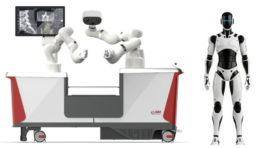
A surgical humanoid, on the other hand, operates in a completely different reality. While it will absolutely benefit from the basic humanoid architecture (such as general-purpose capabilities and proprioception), it requires very different and specialized characteristics.
2.2 Redundant Legs and Fingers
For a surgical humanoid in the operating room, legs are a costly burden. Bipedal legs are a very good design to accommodate stairs and obstacles. However, in surgical theaters, there are no stairs or sidewalks, since everything from patients to equipment is conveyed on wheels. At the surgical table-side, legs take up valuable space that belongs to the operating staff. If we want to give this technology a real chance, we must design these robots to cooperate with surgeons in the foreseeable future, rather than disruptively attempting to replace them while the technology is still far from doing so.
The same logic applies to palms and fingers. Surgeons sew soft tissue using forceps and needle drivers, and they interact with bones using specialized orthopedic drills and saws, rather than using their bare fingers [2]. Therefore, a surgical robot needs instrument interfaces designed specifically for these tools, not a mechanical replica of human fingers.
2.3 Biocompatibility and sterility
Surgical robots must be designed and manufactured from special (and expensive) materials that comply with biocompatibility and cleanliness requirements. The entire system must be designed bottom up to be easily cleanable, disinfected and/or sterilized to meet strict hospital infection control standards (i.e., wearing gloves is not enough…).
2.4 Electrical Safety
Surgical robots must comply with rigorous electrical regulations. This includes strict adherence to rules regarding RFI, EMI, electrical conductivity, specific grounding regimes, management of potential differences and many more, to ensure absolute patient and user safety.
2.5 Precision and Accuracy Requirements
A surgical robot needs to perform delicate surgical activities that frequently require submillimeter accuracy combined with a remarkably high level of confidence. The robotic arms, cameras, sensors, computers, and controllers designed to deliver and maintain this strict precision are inherently complex and expensive. These components command a price point far beyond what the budget of a household robot could ever allow, let alone their complexity, size and weight, which demands a unique design.
2.6 Overall Safety and Regulation
The safety and regulatory landscape for medical and surgical devices is one of the most rigorous in the world. Passing these regulatory hurdles requires careful, predetermined, and mindful design of all hardware and software from inception, alongside years of testing, validation, and clinical trials.
Bottom Line: There is no chance that a household humanoid robot, built to fold shirts for the lowest price possible, could ever withstand these rigorous and demanding regulations and requirements.
3.0 Summary
In the coming years, we will undoubtedly witness a profound revolution in the field of humanoid robotics. However, the AI revolution alone is not enough. While AI empowerment will make all robots smarter and more aware of themselves and their environment, a true Physical AI revolution requires us to specialize the physical aspect of the humanoid robot. We must not be naive in thinking that the exact same robots designed for households will also work in industrial warehouses and operating rooms. While we continuously strive for generality, we undeniably need specialty to conquer highly complex environments. Otherwise, we will invest immense efforts and resources merely to create machines that are equal to us at best. The true benefit of humanoid robots will be realized when they tremendously surpass human capabilities. A household robot will clean without experiencing fatigue or boredom, a warehouse humanoid must be significantly stronger and more robust than a human worker, and a surgical robot must be far more precise and dexterous than a human surgeon. Achieving this, however, requires specialized designs tailored to these unique environments. In this way, the humanoid revolution will become substantially more powerful.
References
- Bar, Y. “Proprioception and Bimanual Architectures in Next-Generation Robotics.”
- Bar, Y. “Defining Physical AI: The Shift Towards Hard Tissue and Spinal Robotics.”
- Bar, Y. “The Dawn of Surgery 3.0: Transitioning from Passive Assistants to Autonomous Therapeutic Agents.”