
By Yossi Bar, CEO and Founder of LEM Surgical
March 7th, 2026
The global surgical landscape is approaching a critical fracture point. Driven by an imminent demographic crisis, where 40% of the orthopedic workforce is aged 60 or older [1], the demand for complex spinal interventions is exceeding human capacity. For decades, the industry has looked to robotics for a solution, yet current systems have been relegated to “single-task machines.” Whether in orthopedics (e.g., TKA), where they provide haptic constraints to guide the resection of a bone plane, or in spine surgery, where they provide passive guidance for a pedicle screw placement, they operate essentially as motorized jigs.
A successful spinal intervention relies on a clinical triad: Fixation, Realignment, and Decompression. While current robotic systems focus almost exclusively on a fraction of the first pillar, the most high-stakes challenges, including global spinal alignment and delicate bone removal, remain manual. This “manual gap” represents the industry’s most significant opportunity for clinical advancement. It is the frontier where robotic participation can most effectively reduce surgical variability and elevate patient outcomes across the entire procedure.
Current conception views the robot merely as an accurate Trajectory Guide. To solve the looming workforce cliff, we must shift the narrative toward Robotics as a Therapeutic Executor and Force Multiplier. We require a system capable of supporting and even performing the non-linear, high-stakes tasks of decompression and realignment that define surgical success. Empowering surgeons with AI computing tools alone will not suffice; we must equip them with Physical AI capabilities to assist in the successful physical execution of the predefined surgical plan.
The Mechanical Trap: Why Accuracy is Not Enough
The evolution of hard-tissue robotics has traditionally centered on implant placement: specifically in spine, the precise drilling of a pilot hole into which the surgeon manually inserts the hardware. While this is a critical task, it is not necessarily the primary driver of clinical outcomes. In spine surgery, while improper pedicle screw placement can lead to adverse events and must be avoided, correct placement alone does not guarantee a successful procedure or the meaningful reduction of pain [2].
There still remains a notable lack of evidence linking superior pedicle screw accuracy to enhanced clinical recovery. This suggests that while current robotic systems have optimized the mechanistic task of fixation, they have remained largely irrelevant to the more complex therapeutic variables that actually dictate patient satisfaction and long-term relief. Implant placement is a deterministic, mechanistic task: a predictable exercise in 3D geometry. However, spinal realignment and decompression are the true therapeutic engines of the surgery, and in these complex tasks, current robotic systems are completely absent.
The Hidden Opportunity: Exposure, Dissection, and Closure
While the primary clinical focus naturally centers on the high-stakes “biological triad” of Fixation, Realignment, and Decompression, there remains a significant “hidden” opportunity for robotic intervention in the manual phases of exposure, dissection, and closure. These foundational steps are often the most time-consuming elements of the procedure. Clinical data indicates that operative time is a continuous risk factor for adverse events; for every 15-minute increase in duration, there is a proportional rise in the incidence of surgical site infections (SSI) and wound dehiscence [11].
In complex spinal fusions, these “non-therapeutic” phases can account for 30% to 50% of total OR time [17], yet they currently receive zero robotic assistance. This represents a massive, untapped frontier for Physical AI. By implementing robotic systems to assist in standardized soft-tissue management and multi-layer closure, we can significantly increase OR throughput and mitigate the physical fatigue that often leads to surgical “time-drift” during the final stages of a case [14].
Platform Synergy: Fusing Architecture, Sensors, and Physical AI
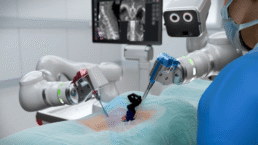
The optimal solution does not reside in a single feature, but in the holistic combination of Physical AI: an advanced robotic humanoid architecture, a plurality of sensors, and continuous computation throughout the procedural lifecycle. While the humanoid form factor is a critical enabler, it is the synergy of the following capabilities that allows for full awareness and execution:
- Bimanual Proprioception: The internal kinesthetic awareness to know tool locations without a continuous external camera’s governance (line-of-sight); The fundamental human ability to tie one’s shoelaces in the dark.
- Plurality of Dynamic Sensors: An integrated suite of dynamic sensors provides continuous, real-time tracking of both internal anatomical motion (e.g., individual vertebral shifts) and the external surgical environment (e.g., the positioning of staff and instrumentation). This enables the system to maintain a high degree of situational awareness, autonomously adapting to the evolving stages of the procedure and the fluid dynamics of the operating room.
- Instrument & Implant Agnosticism: The ability to operate any 3rd party vendor’s instrument and implant through dynamic on-site calibration [3], while decoupling the robot’s therapeutic actions from a specific instrument or implant line.
The Cognitive Buffer: Mitigating Surgeon Fatigue
Beyond mechanical precision, these integrated robotic capabilities aim to mitigate the cognitive and physical burden inherent in the operating room. Traditional single-arm robots can inadvertently increase the “Cognitive Tax” on a surgeon by requiring constant re-registration and line-of-sight monitoring. In contrast, Physical AI is designed to act as a ‘Cognitive Buffer’.
By delegating repetitive tasks to a system that tracks anatomy autonomously and provides bimanual support, the surgeon is relieved from the “Skeletal Fatigue” that can often degrade decision-making during long, complex cases. While Failed Back Surgery Syndrome (FBSS) remains a multifactorial challenge with failure rates as high as 10% to 40% [12], this holistic reduction in mental and physical load represents a significant step toward optimizing the surgical environment and supporting the surgeon’s ability to deliver consistent, high-quality interventions.
Addressing the Manual Gap: Untapped Clinical Procedures
For the practicing spine surgeon, the “Robotic Revolution” has, until now, felt incomplete. Technology has provided tools that assist with the most deterministic part of the case, pedicle screw placement, while leaving the most demanding and high-stakes maneuvers entirely to manual dexterity. Advanced surgical humanoid platforms can offer the ability to bring robotic intervention to high-stake procedures previously considered out of reach:
1. High-Stakes Fixation: Posterior Cervical Pedicle Screw Fixation
- The Clinical Challenge: Cervical pedicle screws (CPS) provide pullout strength nearly four times greater than lateral mass screws (LMS) [4]. However, the technical demands of manual CPS placement are prohibitive; malposition rates as high as 31.6% and perforation rates of 3.9% [6] pose a direct threat to the vertebral artery.
- The Technical Solution: A bimanual humanoid architecture possesses the inherent capability to continuously track and stabilize individual vertebrae during drilling and implant insertion. By utilizing one arm for stabilization and the other for execution, this synchronized approach achieves superior accuracy and clinical confidence, removing dependency on manual stability in the “Danger Zone.”
2. The Realignment Frontier: Global and Segmental Restoration
Realignment must be addressed at both the global and segmental levels to ensure long-term biomechanical success.
- The Clinical Challenge: Restoring the sagittal profile is paramount. Rather than relying on a fixed threshold, contemporary research emphasizes age-adjusted and PI-customized alignment to minimize the risk of Adjacent Segment Disease [7]. Achieving this restoration manually often relies on intraoperative estimation and repeated fluoroscopy, which can lead to compensatory global misalignment [8]. Additionally, Artificial Disc Replacement (ADR) success depends on perfect centering (within 2mm) to restore the natural “center of rotation” [9].
- The Technical Solution: The differentiator here is the core of Physical AI: a highly capable robotic system augmented with multi-modal sensors. While the industry has made significant strides in Cognitive AI, utilizing surgical data science for real-time anatomical recognition and workflow detection [15], the bottleneck remains physical execution. This architecture leverages those cognitive advances to autonomously track individual vertebrae and provide a real-time feedback loop without additional X-ray exposure.
3. Therapeutic Execution: Predetermined and Quantifiable Bone Removal (Decompression)
- The Clinical Challenge: Decompression is a primary technical driver of surgical success. Inadequate initial bone removal is a leading cause of FBSS [11], while excessive removal can cause iatrogenic instability in 12.6% of cases [13].
- The Technical Solution: Humanoid robotics allows for the transition to a Therapeutic Executor. By integrating synchronized bimanual capabilities with specialized power tools and Physical AI sensors, safety is fundamentally guaranteed through a multi-layered design: Individual Tracking: Bone is tracked and stabilized individually to ensure a controlled environment. Sophisticated Algorithms: Execution follows the surgeon’s precise preplanning. Specialized Power Tool: Specialized robotic tools (e.g. Oscillating burrs) are efficient for bone but harmless to soft tissue. This provides the inherent mechanical safety required to ensure delicate organ preservation. Surgeon Supervision: Continuous control via a “dead man switch” mechanism.
4. Bridging the Dexterity Moat: Bi-portal Endoscopy (BESS/UBE)
- The Clinical Challenge: Managing dual channels manually in endoscopic surgery leads to complications like dural tears in approximately 4% of cases [14].
- The Technical Solution: Bimanual coordination provides the necessary synergy. While one arm stabilizes the endoscope, the other operates the tool, significantly reducing the dexterity requirements for the primary surgeon.
The Innovation Catalyst
As demonstrated in the past, once a highly capable platform is introduced, the preliminary applications are quickly challenged and enriched by early adopter surgeons. The procedures detailed above represent only the foreseen horizon of a humanoid robotic ecosystem. By providing a platform with human-like reach and advanced Physical AI, there is no doubt that the surgical community will redefine the boundaries of what is possible in hard-tissue intervention.
Conclusion: From Tool to Orchestrator
By addressing the entire triad, Fixation, Realignment, and Decompression, the humanoid architecture transitions the robot from a single-task tool to a comprehensive teammate. This is the only sustainable way to solve the “workforce cliff.” By offloading the physical demands of bone resection and the cognitive burden of spatial tracking to Physical AI, the primary surgeon is empowered to scale their expertise through parallel sequencing across multiple suites (the ability for one surgeon to supervise multiple robotic suites simultaneously).
This article was written by a Physical Human with the assistance of Artificial Intelligence.
Disclaimer: The following article was written by the CEO and founder of LEM Surgical, a surgical robotics company that commercializes the Dynamis system in the U.S. This article addresses future capabilities, some of which are not yet commercially available in the U.S., and is intended to foster scientific and professional discussion. It should not be considered a commercial or marketing statement
Works Cited
- The Aging Population and Its Impact on the Surgery Workforce. (2006). PMC. [PMC1422682]
- Robotic-Assisted Spine Surgery: History, Efficacy, Cost, And Future Trends. (2019). PMC. [PMC6844237]
- Robotic Hand-Eye Calibration Method Using Arbitrary Targets. (2024). PMC. [PMC12114935]
- Biomechanical Comparison of Posterior Fixation Methods (Lateral Mass and Pedicle Screw). (2020). PubMed. [PubMed 32062472]
- Lateral Mass Screw Fixation in the Cervical Spine: A Systematic Review. (2014). ResearchGate. [Full Text]
- Placement and complications of cervical pedicle screws in trauma patients. (2010). PMC. [PMC2899535]
- Current Concepts of Sagittal Alignment in Spinal Deformity. (2021). PubMed. [PubMed 33583621]
- Spine Sagittal Balance. (2023). NCBI Bookshelf. [StatPearls]
- Cervical Disc Replacement in Athletes: A Modified Delphi Consensus Survey. (2024). ResearchGate. [Full Text]
- Long-term outcomes following lumbar total disc replacement with M6-L. (2022). PMC. [PMC9547696]
- Prolonged operative time impacts complications in spinal surgery. (2025). PMC. [PMC11401372]
- Clinical Insights and Statistical Analysis of FBSS: A Multicentric Retrospective Review. (2025). Asian Journal of Neurosurgery. [PMC12956404]
- Iatrogenic spondylolisthesis following laminectomy: A systematic review. (2015). PubMed. [PubMed 26424349]
- Is Biportal Endoscopic Spine Surgery More Advantageous Than Uniportal? (2022). MDPI. [Full Text]
- Surgical data science for next-generation interventions. (2017). Nature Biomedical Engineering. [PubMed 31015666]
- Navigating Artificial Intelligence In Spine Surgery. (2024). Jefferson Digital Commons. [Full Text]
- Time-motion analysis and surgical workflow modeling in complex spinal procedures. (2023). Journal of Neurosurgery. [PubMed 34213245]